

Vibrancy: Music as a Catalyst
04.20.24 | 29205

For Reflection:
Think about your daily rhythms or routines. When do you feel most aware of your relationship to the rest of the world (i.e., your community, the natural world, etc.)? Where are you at these times?
How might you bring this energy into the rest of your day? What components of this place could transfer into the moments you feel more constrained or muted in your daily life?
Where do you find creativity in your life? Do you have any habits that allow you to be creative and lean into the excitement around that?
Do you have any specific practices that make you feel more energized and vibrant?
How might you adjust your daily habits and routines to promote more vibrancy in your life?
Are you content with your relationship to vibrancy? Why or why not?
I’ve written about singing as a form of meditation and an opportunity to be in community. I’ve written about music as a space you can enter and find calm within. But I’ve never written about it in relation to vibrancy – so, that’s my goal today.
In college, choir became my form of church. I slowly moved away from Catholic mass and formal religious space, finding meaning and community in some non-traditional spaces of spiritual practice and mentorship from some of the campus chaplains and my professors. And normally, when I think about the function of church in a person’s life, I think of it as a place to be open and honest – to be allowed to come as you are, in all your broken pieces, and be healed, if slowly, over time. I don’t really think of church as a place to be made vibrant.
But when I think about the actual end result of all these things – being open and honest, being allowed to come as you are, being allowed to heal and find a place of more stability and wholeness – the result, I hope, actually looks a lot like vibrancy. And, at its best, my experience in choir has been exactly that: vibrant.
My third year at Macalester, we sang a piece called “Meet Me Here.” It’s from a larger masterwork entitled Considering Matthew Shepard, which chronicles the end of Matthew Shepard's life. “Meet Me Here” comes toward the very end of the masterwork and is from the perspective of Matthew’s mother, who offers an invitation for connection and reflection.
I sang the part of the mother in our performances – a mother clearly grieving the loss of her son, grieving the rupture of the path she hoped their lives would take, but also inviting reconciliation through music and dancing. The lyrics bring joy into the story once more with the idea of meeting again and singing together:
Meet me here
Won’t you meet me here
Where the old fence ends and the horizon begins
There’s a balm in the silence
Like an understanding air
Where the old fence ends and the horizon begins
We’ve been walking through the darkness
On this long, hard climb
Carried ancestral sorrow
For too long a time
Will you lay down your burden
Lay it down, come with me
It will never be forgotten
Held in love, so tenderly
Meet me here
Won’t you meet me here
Where the old fence ends and the horizon begins
There’s a joy in the singing
Like an understanding air
Where the old fence ends and the horizon begins.
Then we’ll come to the mountain
We’ll go bounding to see
That great circle of dancing
And we’ll dance endlessly
And we’ll dance with the all the children
Who’ve been lost along the way
We will welcome each other
Coming home, this glorious day
We are home in the mountain
And we’ll gently understand
That we’ve been friends forever
That we’ve never been alone
We’ll sing on through any darkness
And our Song will be our sight
We can learn to offer praise again
Coming home to the light . . .
“Meet Me Here” casts music as the catalyst for overcoming any difficulty. It portrays the act of singing as our responsibility when we are in community together. And in the voicing of this piece, the mother sings solo for the first verse of the piece. The first line the whole choir sings together is “There’s a joy in the singing.” At this line, I distinctly remember feeling a wave of sound, harmony, and warmth surround me when the choir, standing behind me, joined in the singing during each performance. Something beyond all of us, something created by the power of our voices together, took hold in the room at that point. Call it chills, call it the Holy Spirit, call it whatever you’d like – but there are moments, in singing with others, when the sound overtakes everything else, and we are simply in the music – not alone, but with our fellow music makers.
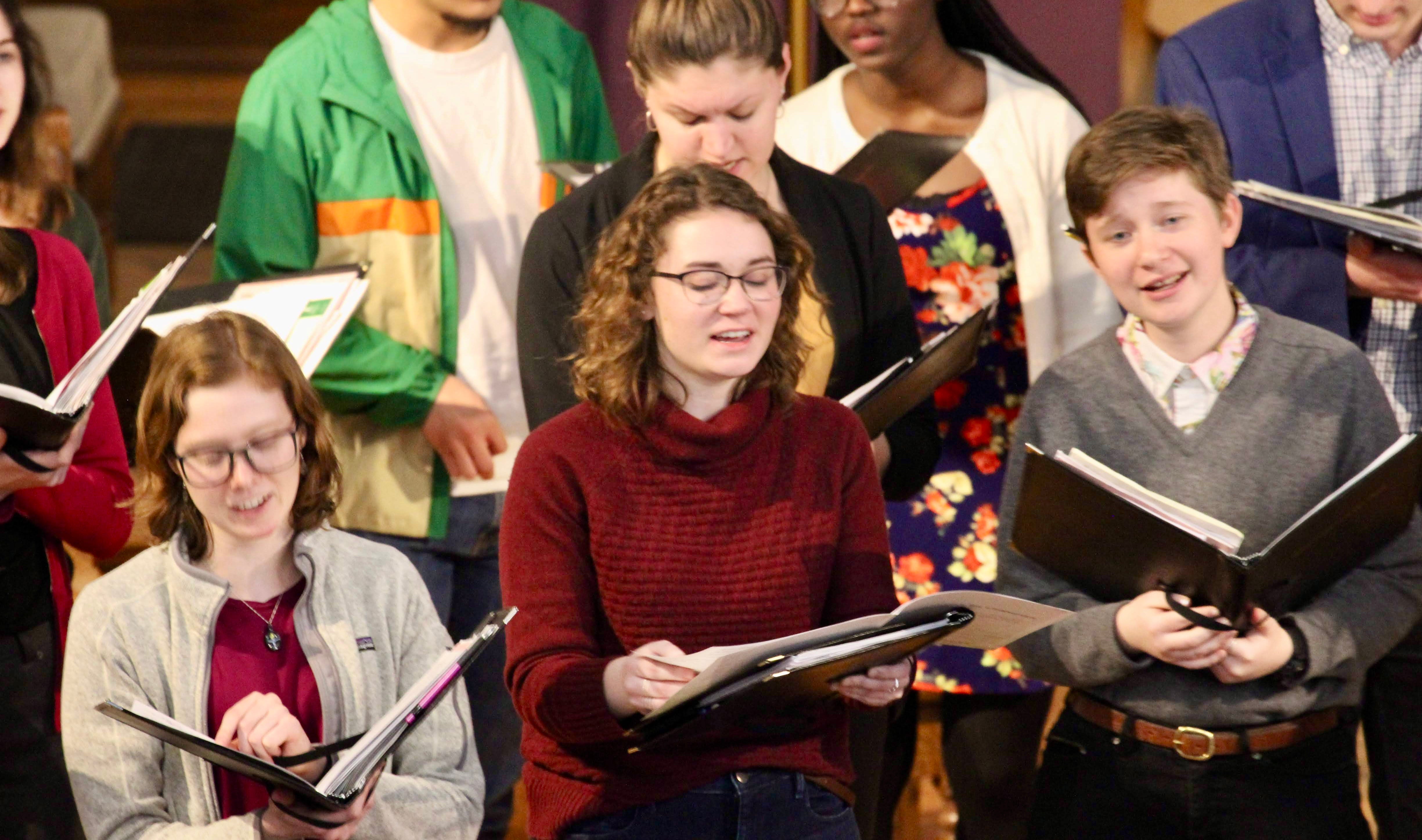
In those moments, I feel vibrant. I feel alive and full of energy. And I think it is at least partially because you can’t hide anything when you’re singing. You are using your body and mind together, and singing with proper technique requires a release of inhibitions. So we come together in honesty, as our fully open, vulnerable selves. As we come together in honesty to sing, we heal together. Over time, we become more vibrant.
What practices make you feel vibrant? Who do you do them with? How does being alone or with others impact the way you feel in these practices? I’d love to hear.
Until next time, friends.